
Why Do I Have to Keep Repeating Myself to Employees?
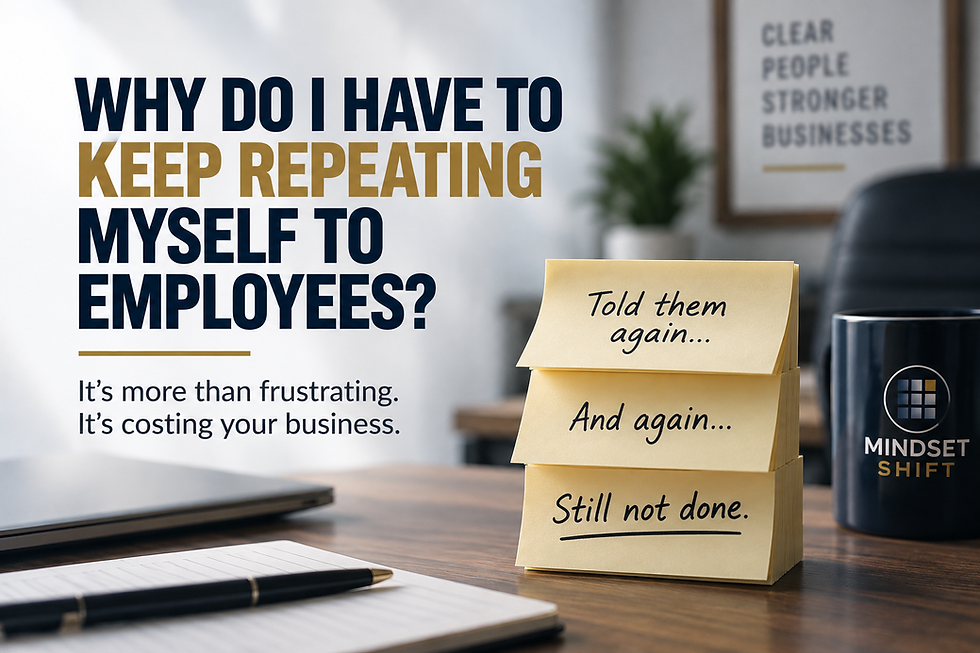
You explained it.
Then you explained it again.
A week later, you're having the same conversation.
At some point, this stops being frustrating and starts costing your business.
You're spending your time following up on things that should already be happening. Managers are repeating instructions. Work gets redone. Details get missed. Productivity slows down. And sometimes customers experience the result.
So why do you have to keep repeating yourself to employees?
The easy answer is:
They aren't listening.
Sometimes that's exactly what's happening.
But if you're having the same conversation over and over with the same person—or across your entire team—it's worth finding out why the message isn't turning into action.
Because repeating yourself again probably isn't going to fix it.
They Heard You. But Did They Know What You Expected?
There's a difference between telling someone something and creating a clear expectation.
Imagine saying:
“I need you guys to do a better job keeping the trucks clean.”
You know exactly what you mean.
Your employees may not.
Does that mean every morning?
After every job?
Who is responsible?
What does “clean” mean?
Who checks it?
What happens when it isn't done?
Now compare that with:
“The driver is responsible for making sure the truck is cleaned out, restocked, and ready for the next day before leaving each night.”
Now there's ownership and a clear outcome.
Sometimes employees aren't ignoring the expectation.
They don't realize what the expectation actually is.
Look at Where You're Repeating Yourself
Before deciding nobody listens, look for the pattern.
Is it one employee?
One department?
One manager's team?
New employees?
Everyone?
The answer matters.
If you have to repeat yourself constantly with one employee, you may have an employee issue.
If you're repeating yourself to everyone, there's a good chance you need to look beyond the employees.
Something in the way expectations are communicated, managed, reinforced, or followed up on may not be working.
The pattern can tell you where to start looking.
Your Managers May Be Saying Something Different
This is something an owner may not see.
You tell employees one thing.
Then a manager changes it.
Or one manager enforces the expectation and another doesn't.
Maybe employees hear:
Owner: “This needs to happen every time.”
Then later:
Manager: “Don't worry about it today. We're too busy.”
Do that enough times and employees learn which expectations are actually expectations and which ones are optional.
From your perspective:
I've told them this over and over.
From theirs:
It depends on who's working.
That's not necessarily an employee listening problem.
It's an inconsistency problem.
What Happens After You Repeat Yourself?
This is a big one.
You address something.
Nothing changes.
You address it again.
Nothing changes.
Then again.
Still nothing.
What happened after each conversation?
If the answer is nothing, the employee may have learned something you didn't intend to teach them:
The conversation is the consequence.
They know you'll be frustrated.
They know there may be another conversation.
But they also know nothing really changes.
Eventually, repeating yourself can actually weaken the expectation.
Not because you weren't clear.
Because employees have learned that follow-through isn't likely.
This is where a communication issue can actually be an accountability issue.
Sometimes the Employee Really Isn't Listening
Not every workplace issue has a deeper organizational explanation.
Sometimes you've been clear.
The employee understands exactly what's expected.
They've been trained.
They have the tools.
Their manager reinforces the same expectation.
They've been given feedback.
And they still don't do it.
At that point, continuing to improve your communication may not solve anything.
You may have a performance issue.
That's an important distinction.
An employee who doesn't understand the expectation needs clarity.
An employee who understands it and repeatedly chooses not to meet it needs accountability.
Those aren't the same problem.
And treating them like they are can waste a lot of your time.
Stop Fixing It for Them
Sometimes the reason you're constantly repeating yourself is because you've become the safety net.
Something gets missed.
You catch it.
Someone doesn't follow through.
You remind them.
A deadline approaches.
You check on it.
They forget something.
You fix it.
The work gets done, but only because you're constantly making sure it gets done.
That's exhausting.
And it can create a business that depends too heavily on you.
The question becomes:
Are your employees learning to take ownership—or learning that you'll eventually step in?
Your time has a cost.
Every hour you spend reminding someone to do something they've already been told to do is an hour you're not spending on customers, growth, planning, sales, leadership, or something else the business needs from you.
More Communication Isn't Always the Answer
When things aren't happening, businesses often respond with more communication.
Another meeting.
Another email.
Another group text.
Another policy.
Another reminder.
Another sign on the wall.
But if the real issue is inconsistent management, unclear ownership, lack of accountability, a broken process, or the wrong employee, more communication just creates more noise.
Before adding another meeting or reminder, ask:
Why didn't the last conversation change anything?
That's a much more useful question.
Why Do I Have to Keep Repeating Myself to Employees?
If you're asking “Why do I have to keep repeating myself to employees?”, look at a few things before having the conversation again:
Was the expectation actually clear?
Does the employee know exactly what they're responsible for?
Is everyone communicating the same expectation?
Or are managers sending mixed messages?
Does the employee have what they need to do it?
Training, information, authority, time, tools?
What happens when the expectation isn't met?
Is there follow-through—or just another reminder?
Is this happening with one person or multiple people?
That can tell you a lot about where the issue may be.
And finally:
Does the employee understand what's expected and simply not do it anyway?
If so, you may not have a communication problem anymore.
If You Keep Having the Same Conversation, Look for What's Underneath It
This is where owners can lose a lot of time.
The visible problem is:
“My employees don't listen.”
So you communicate more.
But maybe the actual issue is that a manager isn't reinforcing expectations.
Or responsibilities aren't clear.
Or there are no consequences.
Or the process makes it difficult to do what you're asking.
Or different people are giving different instructions.
Or one employee simply isn't willing to meet the standard.
Those require completely different solutions.
If you keep having the same conversation, the conversation probably isn't the real problem.
Find out why nothing changes after it.
Frequently Asked Questions About Employees Not Listening
Why do I have to keep repeating myself to employees?
You may need to repeat yourself because expectations aren't clear, managers are giving conflicting direction, employees lack training or authority, there's little follow-through, or the employee understands the expectation but isn't meeting it.
Look at whether the issue is happening with one employee or throughout the company. The pattern can help identify where the actual problem is.
What should I do when an employee doesn't listen?
First determine whether the employee didn't understand the expectation or understood it and didn't follow it.
Be specific about what was expected, what happened instead, and what needs to happen going forward.
If the expectation is clear and the same issue continues, it may need to be addressed as an accountability or performance issue rather than another communication issue.
How do I communicate expectations clearly to employees?
Make sure employees know what they're responsible for, what the expected result looks like, when it needs to happen, and who owns it.
Avoid relying on vague expectations such as “do better,” “communicate more,” or “take more initiative” without explaining what those expectations look like in practice.
Why do employees keep making the same mistakes?
Repeated mistakes can have different causes, including unclear expectations, inadequate training, poor processes, conflicting instructions, lack of follow-through, workload issues, or employee performance.
Before correcting the mistake again, look for the pattern behind why it keeps happening.
How do I know if it's a communication problem or an employee problem?
Look at how widespread the issue is.
If one employee repeatedly struggles with expectations that everyone else understands and follows, the issue may be individual performance.
If multiple employees are confused or making the same mistakes, look at communication, management, training, processes, and expectations before assuming you suddenly have multiple bad employees.
What if I've talked to an employee several times and nothing changes?
If expectations are clear, the employee understands them, has the ability and resources to meet them, and the same issue continues despite feedback and appropriate support, another conversation may not solve the problem.
At that point, determine whether stronger accountability, additional development, a role change, or a personnel decision is appropriate.
Still Having the Same Conversation?
If you've addressed the same issue over and over and nothing changes, stop assuming another reminder will fix it.
There may be something underneath the problem that isn't obvious from where you sit.
A Workplace Reality Assessment looks at what's actually happening inside your business—including communication, expectations, accountability, management, processes, and what employees experience day to day—to help identify what's driving the issue.
The answer might be clearer expectations.
It might be a manager.
It might be a broken process.
It might be accountability.
And sometimes, it really is the employee.
Find the real problem before you spend more time fixing the wrong one.


Comments